
Why can’t solar panels go on buildings rather than in fields? Won’t this harm food production and damage nature?
We’ve been asked why solar panels have to go on farmland and aren’t going on people’s houses and retail properties. Is this endangering our food supply? Is doing this bad for the natural world?
Ideally solar panels would be going on a lot more buildings than they are. There are probably two main reasons they aren’t. The first is that they are expensive: they cost c. £5,000, so a lot of people can’t afford them even if they pay for themselves in time. The second concerns ownership: a lot of
people and businesses rent, so the division of interests between landlord and tenant makes installation difficult.
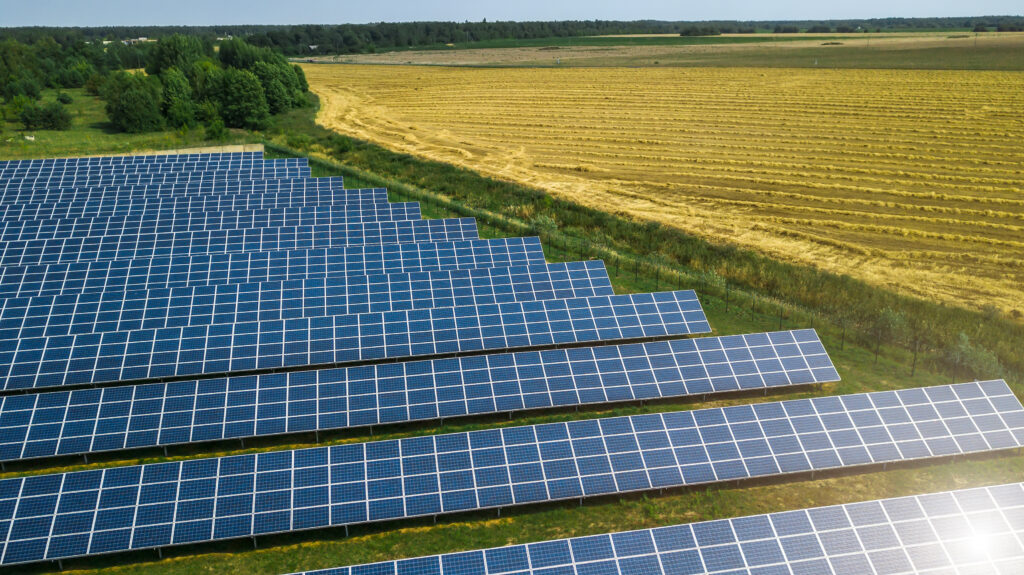
Another point is that the amount of energy we could get from rooftop solar is quite limited. The maximum solar installation you can get on a private residence without seeking special dispensation is 3.7 kW (due to grid connection issues), whereas the solar farms being developed locally have a capacity of between 20 and 50 mW. So to provide the same capacity as one of those farms from rooftop installations, you’d need to install panels on between 5,400 and 13,500 rooftops. That’s difficult, and there aren’t that many rooftops around, so even if we did this a lot more it wouldn’t reduce the need for farm-scale installations by very much.
We shouldn’t worry too much about reduction in food productivity from solar farms, for several reasons. First of all, the quantity of land likely to go to solar farms is very small: 0.5% of UK farmland, and about half the land taken up by golf courses – and as we’ve yet to see any “dig for victory” style campaign for turning golf courses over to food production, we can probably infer that this doesn’t threaten any immediate food crisis. And as the biggest threat to agricultural production is climate change – due to more droughts, flooding, invasive pests and diseases, etc – this is probably a good investment in saving the productivity of other land that remains in cultivation. In short, given the small amount of land involved, not building the farms would probably be worse for British food production than building them.
This is especially so as the solar farms are generally being built on lower quality, 3b land, described by government as “moderate quality agricultural land … capable of producing moderate yields of a narrow range of crops, principally: cereals and grass; lower yields of a wider range of crops; high yields of grass which can be grazed or harvested over most of the year”. So as well as wheat, they’re often used for animal feed, or biofuels. Mention of biofuels raises an important issue – basically, biofuel production uses up 77 times more UK farmland than solar panels, and are much less productive of energy, so if there is a “renewable” culprit it’s them. The thing is, you can’t tell by looking at a field that that’s how it’s being used, so biofuels tend to get a free pass, even though their status as “renewables” is questionable.
For the stats these arguments are based on, and further information, see this investigation by Carbon Brief.
The other thing, of course, is that eating and therefore farming less meat would free up a lot of land, which would more than cover the space needed for solar farms and rewilding/tree-planting, whilst allowing us to produce the same quantity of food on less land. On the other hand, solar farms can be combined with some sheep grazing, or in some conditions, fruit & veg production.
In the end we are going to need to take a much more fundamental look at the resilience of our food systems in the face of climate change with all the difficult impacts that are coming. In a few decades time, when we have a lot of renewable energy, it seems a reasonable guess that we will probably start producing a bigger share of our food in vertical farms, which hardly use any land or water and are immune to weather and pests, though at present they don’t make sense because they’re still very energy intensive.
As to tree-planting and habitats, all solar farms are now required by law to achieve a net gain in biodiversity, and this is very easy to do by rewilding the meadows at the base of the solar panels. This also allows land used for cereal crops to recover from the soil degradation caused by years of ploughing and chemical fertilisation. So solar farms are generally much better for nature than standard arable or (in most cases) pastoral farming.
Solar farm proposals generally include extensive tree and hedge planting to screen the panels from various viewpoints, in order to limit complaints about them spoiling the countryside. So even if a small number of trees or hedgerows sometimes have to be taken down to enable construction, in the medium term solar farm proposals tend to be positive for tree coverage, and from a carbon perspective any loss of trees is obviously outweighed by the renewable energy provided.
You can read more detailed treatments of some of these arguments here.