
Community Owned Solar Panels – Interview
Community owned solar panels: The Heart of England Community Energy
Story
An interview with John Stott
Listen to the interview using the player above or read the summary below. The timing of each section in the recording is shown in Minutes:Seconds
First steps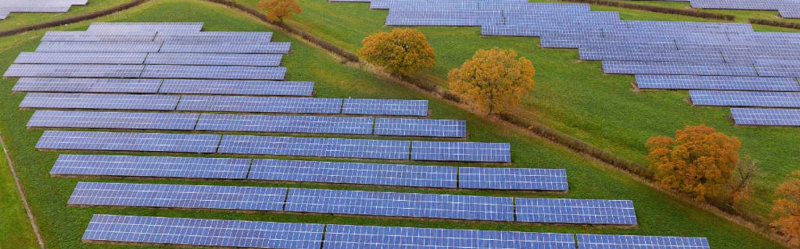 John became interested in the climate problem at the beginning of the millennium and had put together the plan for a local wind turbine when he discovered that other people had been doing similar things and there were opportunities to invest in community solar farms. When he received an email asking him if he would be interested in investing in a solar farm near Stratford on Avon, he responded positively and was invited to a meeting in Coventry, where he learned that a solar farm at Drayton Manor had already been built and that it was required by law to offer part of this for community energy. The company had tried to market three of its nine solar farms for community energy but failed to attract investors. An asset management company, Mongoose, managed solar farms on behalf of community groups and had registered a company in the name of Portway Community Energy, which became the legal entity for the purchase of the three solar farms. Mongoose then set about recruiting local directors.
00:00
Attracting investors
With the assistance of Mongoose, a share offer was raised for investments in what became Heart of England Community Energy. When the two representatives of Mongoose then withdrew as directors, John became chair. He was prepared to do this because he had solar panels and his engineering background had proved valuable when he researched this. It turned out, though that as a director you also needed to be an expert in high finance and hay.
02:29
Finance and farmland
As well as paying for the solar farms, the company also took on the original short-term mortgages taken out to finance the building of the panels, which had to be re-financed. They raised a share offer and two bond offers, attracting local investors who were regularly paid 6% p.a. The reason for needing to know about hay is that the land on which the farms are built is contaminated, so nothing can enter the food chain. However, the grass needs to be mown, and the original management plan stated that this had to be left to dry for two or three days and then gathered up. If it’s left to mulch, it enriches the soil, but wildflowers thrive on impoverished soil, so it needs to be removed. Ecologists have confirmed that
the current arrangements are effective.
03:58
Community benefits: fuel poverty
Early on, Heart of England Community Energy (HECE) engaged with Act on Energy, providing money to employ someone to help people in fuel poverty and when this ended they moved on to a Complex Case Worker project with the same object, to help people with other issues surrounding fuel poverty. This has
been so successful that in the light of it both Stratford and Warwickshire district councils have started similar projects.
06:10
Other community benefits, local and global
Citizens Advice had funds to help people in hardship and HECE paid for extra administrator time to improve throughput. They also provided funds to overcome restrictions in the distribution of benefits. HECE also provides money for solar lighting systems in Africa because the benefits per pound spent far outweigh those in this country. In addition the company has given money to the Stratford food bank and co-funded the Christmas hamper project to the tune of £6,000.
07:42
Soft loan scheme
HECE has also recently introduced new a soft loan scheme for carbon saving which has attracted a number of enquiries. When it begins, loans are to be paid back in 20 years out of the savings arising. Applicants need to provide “half- hour” data showing details of consumption as reassurance that the loan will be paid off because at the end of the period the loan is written off. It’s an uncomplicated arrangement.
09:23
Change of asset manager
Circumstances meant that the directors sought another asset manager, settling on Communities for Renewables, a not-for-profit organisation with whom they have a good relationship. Each solar farm is a separate company, as is HECE, so the situation is complicated and even though the asset manager deals with this, “you feel responsible and you want to make sure it’s okay.”
10:25
Electricity generated by the panels
Over the course of a year the panels generate enough electricity for 4,000 homes. Unfortunately, this can’t be supplied to customers directly because in order to do this it’s necessary to be registered as a company, which requires a great deal of paperwork and is extremely expensive. HECE simply can’t afford it. “We’d love to be able to sell to local people, but right now you can’t do that.”
11:38